


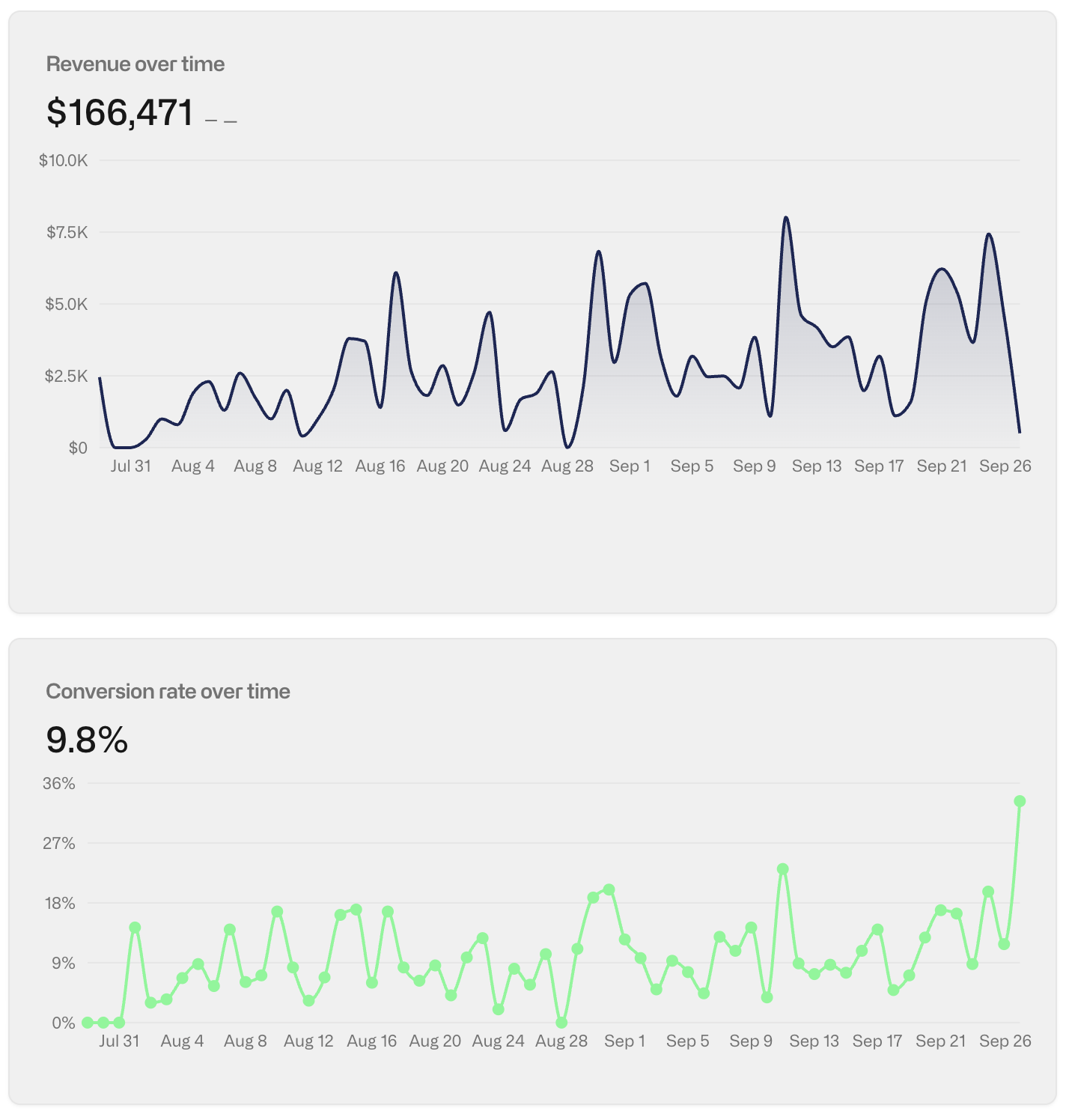
In 57 days we went from an idea to a business that has taken $166,471 in revenue and is on track to pass $1 million in its first year. I didn't hire a developer. My team and I vibe coded it for a client with AI tools, and the site converts cold traffic at 9.8%.
This is the full case study, step by step, so you can copy the process. I've kept the brand name private (it's a platform that recognizes local businesses with awards), but every number and screenshot here is real.
Here's the system in nine steps, plus the part nobody talks about. Most people skip the research, the offer and the pricing. That's usually why their product doesn't sell.
Step 1: Find the idea, then find what customers hate about the competition
Before building anything, check whether something like your idea already exists. If it does, that's good news. It means people already pay for it.
- List the competitors. Search for the product you want to build and write down every company already selling it.
- Mine their criticisms. Read their Trustpilot, Google and Reddit reviews. Look for the complaints that come up again and again (price, trust, quality, slow delivery, poor support).
- Turn each complaint into a feature. Every repeated criticism is a gap. Your product is built to close those gaps.
You can do all of this with AI. Ask Claude to list the competitors in your space, then paste in their reviews and ask it to group the complaints by theme.
Step 2: Build the offer with Claude and the value equation
A good product with a weak offer won't sell. I used Claude to build the offer around Alex Hormozi's value equation from his book $100M Offers:
Value = (Dream Outcome × Perceived Likelihood of Achievement) ÷ (Time Delay × Effort and Sacrifice)
In plain terms, you raise value by making the result bigger and more believable, and by making it faster and easier to get.
How to do it:
- Give Claude your competitor research from Step 1.
- Ask it to score your offer against each part of the equation.
- Ask it to suggest changes that push each part in the right direction (guarantees, bonuses, faster delivery, less work for the customer).
- Repeat until you have an offer you'd buy yourself.
Step 3: Vibe code the website with a JSON prompt
Once the offer was locked, I asked Claude to turn it into a detailed JSON prompt for Lovable, the AI website builder. A JSON prompt is a structured brief: every page, section, headline, button and feature laid out in a format the AI can follow exactly.
Why JSON instead of a normal message? It removes guesswork. Lovable builds what you specified, not what it assumes you meant.
- Ask Claude: "Turn this offer into a JSON prompt for Lovable to build a conversion-focused website."
- Paste the JSON into Lovable.
- Review what it builds, then refine with short follow-up prompts.
New to Lovable? Sign up with my invite link and you'll get 10 extra credits to start building. (It's a referral link, so I may get credits too.)
Step 4: Wire up the business stack
A website isn't a business until it can take money, send emails and tell you when someone buys. Here's the stack I connected to the Lovable site:
- GoDaddy (custom domain): bought the domain and pointed it at the Lovable project.
- Google Workspace (branded email): connected to the same domain.
- Klaviyo (follow-up email flows): connected to Lovable, and Lovable wrote the flows.
- Stripe (payments): connected to Lovable's checkout.
- Slack (live order alerts): Stripe sends each order to a Slack channel via a webhook.
The Klaviyo flows do three jobs: recover people who abandon checkout, upsell new customers, and ask for early feedback. I had Lovable write all of them.
The Slack alerts use Slack webhooks. If you haven't set one up before, ask AI or search "Stripe to Slack webhook". It takes about ten minutes, and seeing orders land in real time keeps you close to the business.
Step 5: Price for at least a 70% gross margin
Set your price on two things: what the offer is worth to the customer, and what it costs you to deliver.
My rule is a minimum 70% gross profit margin. That means if you sell something for $100, it should cost you no more than $30 to fulfill. The margin is what pays for advertising while you're still finding what works. Without it, every sale you buy with ads loses you money.
A quick test: take your price, subtract the cost of delivering one order, and divide by the price. If the answer is under 0.7, raise the price, cut costs, or rethink the offer.
Step 6: Start cold email on day one
You don't need to wait weeks to warm up email inboxes. I opened an Instantly account (cold email software) and bought their pre-warmed email accounts so I could start sending straight away.
Then:
- Define your ICP (ideal customer profile): exactly who buys this and why.
- Export a list of leads that match the ICP.
- Test five different offers or wordings against that list and keep the winner.
My four cold email rules
- Keep it under 80 words. Short emails get read. Long ones get deleted.
- No links in the email. Links hurt deliverability and make you look like spam.
- Cut the marketing language. Avoid words like "free", "$", "5X", "10X", "pay nothing" and "money back". Write like a person, not an ad.
- Make replying effortless. My call to action was: "Reply with the word AWARD and I'll send you the link." Pick one word that fits your business and ask for that.
Step 7: Let an AI agent handle replies and follow-ups
Replying to every lead by hand doesn't scale. I set up Grokbot, an AI agent, to run the inbox for me:
- Every hour, it checks the Instantly Unibox for new replies.
- When someone replies with the keyword, it sends back a pre-written reply with the link and a short piece of useful information.
- Every 48 hours, it follows up with anyone who asked for the link: "Did you get a chance to look? Any questions?"
That's the whole follow-up process, running without me. Most sales happen in the follow-up, and most people never send one.
Step 8: Launch Meta ads with simple creative and real photography
Cold email alone won't get you to scale. Meta ads did most of the heavy lifting.
Campaign setup
- One prospecting campaign, built from scratch.
- Targeting: engaged shoppers, plus business owners, agency owners, small business owners, and anyone with CEO or founder in their job title or an interest in small business. I added every relevant suggestion Meta offered in detailed targeting, plus the obvious ones.
- Retargeting campaign: added after first 30 days (to capture previous website visitors since the site lauched - NOTE: your meta pixel must be active on the site from day 1 to eventually do a retargeting campaign)
Creative
- Three ads to start, all flexible format, all static images. No video, it's too expensive to start.
- I wrote the ad copy, then used my designer at MTHD to create variations of the text and to design ads from our photos.
Photography
We paid a photographer for 30+ product images and used them across the website and the ads. It was one of the best investments we made. Good photography shows you've put care into your brand, and attention creates attention.
Step 9: Track everything and fix the leaks every day
You can't improve what you can't see. I set up three free layers of tracking:
- Lovable analytics: every visitor and where they drop off in the funnel.
- Google Analytics 4: traffic sources and conversions.
- Microsoft Clarity: heatmaps, session recordings and dead clicks.
The daily routine: every morning we checked the site's conversion rate, then asked Lovable at which step people dropped out. We fixed that step, and repeated the next day.
That daily loop is how the site reached an all-time conversion rate of 9.6% on purely cold traffic, for a brand new business with no audience. Most sites are happy with 1 to 3%.
The results, and the part nobody talks about
- Time from launch to today: 58 days
- Revenue to date: $166,000
- Meta ad spend to date: $70,000
- Total invested (ad spend, software, AI tokens, Cold email inboxes etc): ~$85,000
- All-time conversion rate (cold traffic): 9.8%
- This month vs last month: projected at almost 2x
- Projected annual revenue: $1M+ and growing at about 2x from month 1 to month 2.
Now the honest part. Back in the day, if you wanted to start a business, you sold your house, took out a second mortgage, got a bank loan or put it on a credit card. You bet on yourself.
Somewhere along the way, people were sold a myth: make one reel, go viral, get rich. Build something cool and the customers will come. It isn't true.
You have to fund the attention until the business earns its own through reviews, proof and word of mouth. We spent $70,000 on Meta ads to make $166,000. A lot of that early spend was tuition: testing what works and cutting what doesn't.
That's just business. Your first five ads might cost you $10,000 and make nothing back. But every day you learn what works and what doesn't. You double down on the winners, kill the losers, and that's how a profitable business gets built.
Every business needs startup capital. Counting Meta ads, Instantly, AI token costs and everything else, we invested roughly $85,000 (plus our time) to get here. That early work is now paying off: this month is projected to bring in almost double what last month did. It snowballs.
Your reward matches what you're willing to bet
This is the part that gets lost. The size of your reward is tied to how much you want to invest and how much you bet on yourself.
- Want an extra $5,000 a month with $1,000 to invest? You can probably do it.
- Want a million dollar business? Be ready to put your money where your mouth is.
- With $5,000 to spend, a $1M-a-year business is unlikely. With $50,000, it's far more realistic.
Set your goal based on what you can invest, and you'll land on a realistic target.
So, can you vibe code a million dollar business in 57 days?
Yes, you absolutely can. On its current sales trajectory, this business will make more than $1 million in a year, and the growth numbers say it will make a lot more than that.
But you've been lied to about how easy it is. AI made the build fast and cheap. It didn't remove the hard part. You'll need to work harder than you ever have, plan carefully, and fund the attention until it pays for itself. The 70% margin from Step 5 is what makes that investment survivable. And even if you don't have $85k to invest, reset your expectations to build a $100k business and scale from there.
If you need more 1 on 1 help, you can consider hiring our agency. Check it out here.